The short answer
ChatGPT can talk about astrology fluently. What it can't reliably do is work out where the planets were when you were born. When the model behind free ChatGPT answered on its own, 49 of 50 charts put at least one placement in the wrong sign, and 46 had a planet in the wrong sign. With a birth time, the Rising sign, the one everyone asks about, was wrong in 33 of 40 charts.
In the ChatGPT app it often looked up an ephemeris on the web first. That fixed most of the planets, but not the parts that have to be calculated: 3 of our 5 app charts still had a sign wrong.
The readings themselves sounded confident and well organized. Nothing in them signalled which parts were wrong, and if you don't already know your placements, you have no way to tell.
How we tested
- 50 made-up people, no real birth data. Birth dates from 1960 to 2004, in 50 cities on every inhabited continent, north and south of the equator. 40 had a birth time to the minute; 10 had none.
- The question a person would type. "I was born on [date] at [time] in [city]. Can you work out my birth chart?", asking for the Sun, Moon, Rising and every planet through Pluto, with degrees.
- Free ChatGPT's model. GPT-5.6 Luna, the default for free ChatGPT in October 2026, through OpenAI's API with default settings, on October 4, 2026.
- Five of the same births in the ChatGPT app. Logged out, in a private window, the way most people first try it, on October 4, 2026.
- An answer key from real astronomy. Every reply was checked against a chart computed with an astronomical ephemeris (astronomy-engine), the same engine behind our free birth chart calculator. On the published charts of public figures such as Barack Obama, JFK and Princess Diana, it matches the Sun and Rising to the minute.
We counted a placement as wrong when ChatGPT put it in a different sign. Because a placement can sit a fraction of a degree from the edge of a sign, we also counted the clear misses separately: placements more than 5° from where the planet actually was. Without a birth time nobody can know the Moon's exact place that day (it moves about 13° a day), so the Moon was only scored for the 40 births with a time. Houses weren't scored, because house systems differ.
What the model got wrong on its own
| Placement | Wrong sign | More than 5° off |
|---|---|---|
| Rising sign | 83% (33 of 40) | 90% |
| Venus | 58% | 76% |
| Mercury | 44% | 64% |
| Moon | 43% (17 of 40) | 65% |
| Mars | 36% | 58% |
| Jupiter | 12% | 24% |
| Saturn | 12% | 14% |
| Uranus, Neptune, Pluto | 6–8% | 6–8% |
| Sun | 0% | 0% |
Here is what that looks like in a single chart. For someone born at 5:31 PM on September 5, 1977, in London, ChatGPT got the Sun right: Virgo, 12°, against a true 13°. It then put both the Rising sign and the Moon in the exact opposite signs (Cancer rising instead of Capricorn, a Sagittarius Moon instead of Gemini), and moved Venus and Mars into signs they weren't in.
What happened in the ChatGPT app
In the app, ChatGPT usually searched the web for an ephemeris and worked from what it found. That made the planets much better: across our five app charts, nearly all of them were in the right sign. But the parts that have to be calculated for your exact time and place still went wrong.
For the London birth (5:31 PM, September 5, 1977), it gave a Gemini Rising sign. The Rising sign was Capricorn.
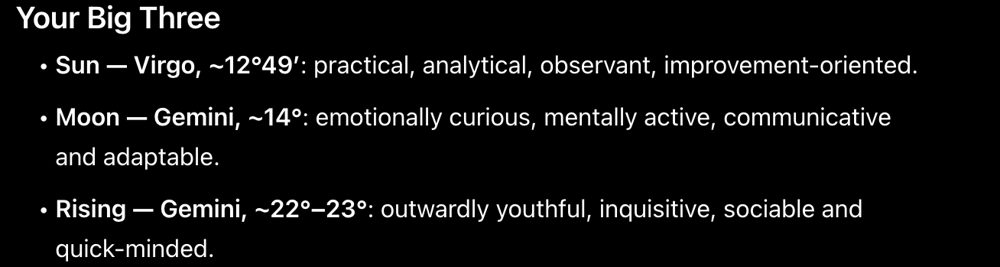
For the New York birth (2:42 PM, August 22, 1970), it said the Sun was “in very early Virgo, rather than Leo”, and cited a website for it. At 2:42 PM that day the Sun was at 29°14′ Leo. It entered Virgo at 9:34 the next morning.

In the same New York chart its Rising sign was right, Sagittarius, but 11° off. In the Buenos Aires chart it put Saturn in the wrong sign, right at a sign boundary. For both births without a time, it said the Rising sign can't be known, which is correct.
Five charts aren't enough for a percentage. They are enough to show that a web search doesn't turn a chatbot into a chart calculator.
What it got right
To be fair to it: answering on its own, the model got the Sun right in all 50 charts, almost always to within a degree, and the slow outer planets were mostly right. When no birth time was given, it said every time that the Rising sign and houses can't be known without one, which is exactly the right answer. It didn't invent one.
In a small spot check of 4 charts, the model behind paid ChatGPT plans (GPT-5.6 Sol) did better: its Rising and Moon were right in all 4. Two of the 4 still had a planet in the wrong sign.
Why this happens
A chatbot like ChatGPT predicts likely text. Unless it runs an astronomical calculation, it isn't working out where Venus was at 5:31 PM on a Monday in 1977. It's writing something that sounds like a chart. Sun signs are easy, because the date ranges for each sign appear everywhere it learned from. The placements that move fast are where the guessing shows:
- The Rising sign changes about every two hours, so it depends on the exact time and the exact place.
- The Moon changes sign every two to three days.
- Mercury and Venus stay close to the Sun but move unevenly and turn retrograde, so a nearby guess often lands in the next sign.
How to get an accurate reading from ChatGPT anyway
Interpretation is the part a chatbot is genuinely good at. Calculation is not. So split the job:
- Compute your chart with a real calculator. Any tool that uses an ephemeris will do. Ours is free and needs no account; it gives you every placement by sign, degree and house.
- Paste your placements and ask for interpretation only. Something like this:
Here is my birth chart, computed with an ephemeris: [paste your placements]. Use only these placements. Don't recalculate anything, and don't add aspects, transits or degrees I haven't given you. If something you'd need is missing, say so instead of guessing. Then help me think about [what's actually on your mind].
That last line matters more than it looks. A chart read in the abstract tends to come back as a personality description. A chart read against something you're actually living through (a decision, a relationship, a year that feels like a turning point) gives you something to work with.
Where The Architect fits
The Architect is a private journal with a mentor that builds on what you share. If you give it your birth details, it computes your chart with the same ephemeris (sign, degree, house) and keeps it with your journal. The mentor uses your chart only when it's relevant to what you're writing about, never as a daily horoscope, and it works from your placements exactly as computed. One of its voices, The Mystic, meets astrology inside your own way of seeing things, then brings it back to the week you're actually in.
You can see your exact chart free without an account, or ask your mentor about it. Your first 11 mentor responses are free.
About this test
The 50 charts went through OpenAI's API with default settings, which is the model answering on its own, without web search. The five app charts were run in the ChatGPT app, logged out, and transcribed from screenshots. Both were done on October 4, 2026, with GPT-5.6 Luna, the free model at the time; models change often. The births were invented for the test, so no real person's details were used. The 50 charts gave about 530 scored placements: enough to show a clear pattern, not a precise error rate for any single planet.